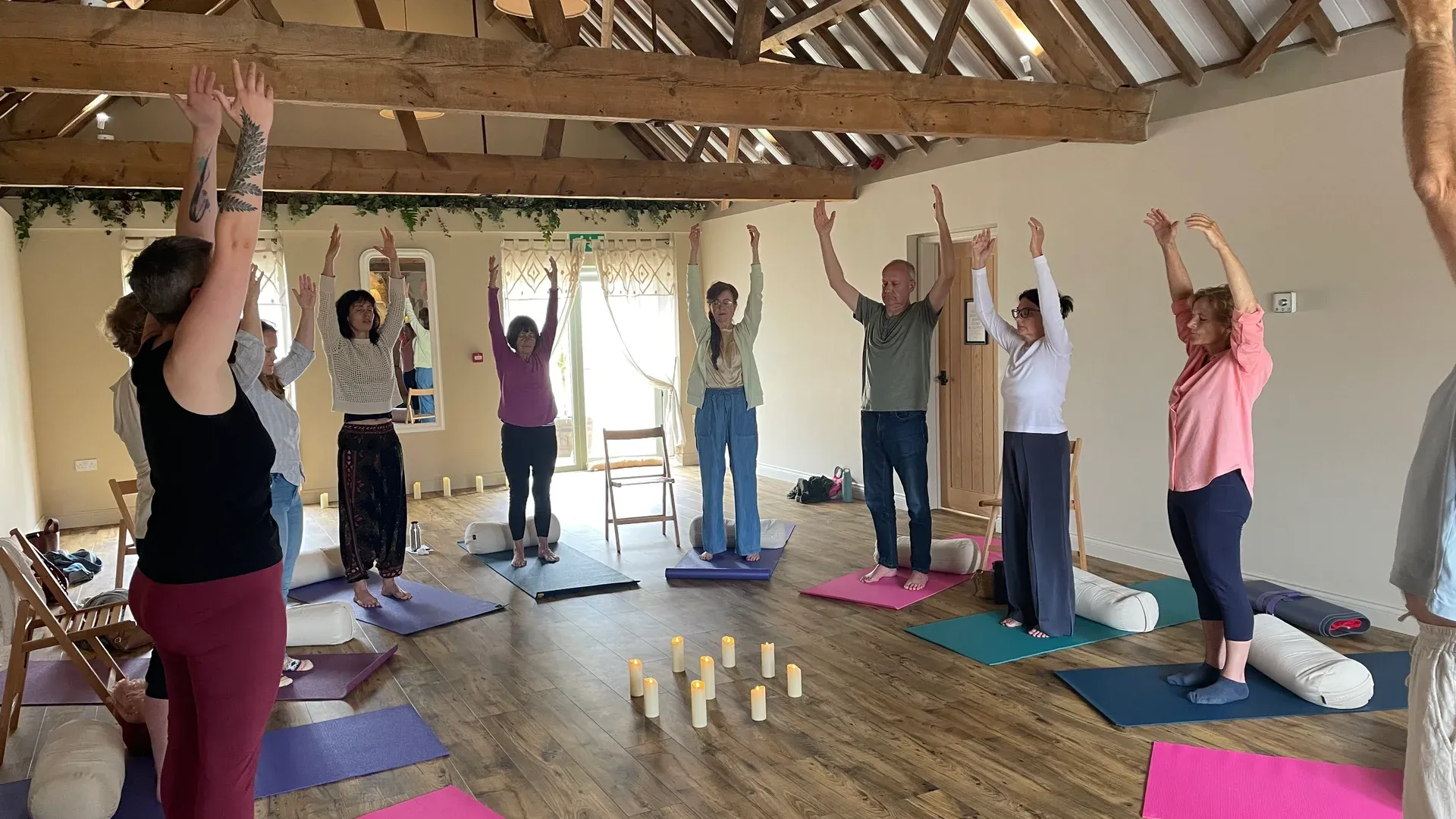
The palm tree before sitting, the breath held at both ends, and a technique that asks you to stop trying so hard.
Twelve of us this month, which is the largest group we have had, and the room at The Painted Barn took it comfortably.
We opened where we finished last time. A recap of the previous session, then space for questions about personal practice, which is usually where the most useful teaching happens. The questions people bring back after a month of sitting on their own are rarely theoretical. They are practical, specific, and often the same difficulties in different clothes.
Standing first: talasana and the field around the body
We began standing, in talasana, the palm tree pose.
It is easy to treat a standing posture as preparation for something else, a place you pass through on the way to the real work. Talasana is not that. The whole body lengthens upward through the arms, and the intention is not simply to stretch. Energetically, the posture draws energy down and through the arms and gathers it into the body.
The method for that gathering is one of the things we keep for the room. Some of yoga is passed on in person or not at all, and this is one of those parts: written down it would be a sentence, and a sentence is not the thing. If you were there on Saturday, you have it. If you were not, come in August and you will.
From there we worked with the sense of the body’s external energy field: the felt sense of the space immediately around you. This is one of those practices that sounds abstract until you try it, and then becomes surprisingly concrete. What you are training is the same faculty you will need later: the capacity to notice something subtle without grabbing at it.
The breath held at both ends
Then to the breath, and something new for this group.
We have worked with maha yoga pranayama, the complete yogic breath, since the first session: the three-part inhale that fills the abdomen, then the ribs, then the chest, and the exhale that reverses it. This month we added retention at both ends. Antara kumbhaka, the pause after the inhale, when the lungs are full. Bahya kumbhaka, the pause after the exhale, when they are empty.
Full retention and void retention feel entirely different from one another, and both feel different again from ordinary breathing. Retention is where pranayama stops being a breathing exercise and starts being something else. It is also where care matters most: never strain, never hold past the point of comfort, and come out of a retention before the body demands it rather than after.
What came back afterwards was interesting and consistent. Several people noticed a distinct increase of heat in the body. Alongside it, a state of calmness that had arrived without being pursued. That combination, warmth and settledness together, is characteristic, and it is a useful marker: it tells you the practice is doing something, and that you were not simply sitting still and hoping.
Capturing the Uncaught Mind
The main technique of the session came from the Tibetan meditation tradition, and it carries the wonderful name Capturing the Uncaught Mind.
Almost everything we have practised so far has been a form of concentration: choose an object, place attention on it, notice when it wanders, bring it back. That is Dharana, and it is the foundation. But it is not the only way in, and for some people it is not the most natural one.
This technique works differently. Rather than gathering the mind to a single point, it asks you to remain the witness: to let what arises arise, and to stay as the one who notices, rather than the one who chases. The mind is not captured by being pinned down. It is captured by being watched.
If you have ever found concentration practice frustrating, if the effort of returning attention again and again has felt like failure rather than practice, this is the approach worth sitting with. It does not demand that the mind be quiet. It only asks that you keep watching, and it develops awareness rather than force.
Tapas: the discipline that keeps a practice alive
Afterwards we turned to tapas, the third of the Niyamas.
Tapas is usually translated as discipline, sometimes as austerity, sometimes literally as heat. It is the quality that gets you onto the cushion on the days you would rather not, and it is the difference between someone who has meditated and someone who has a practice. Not intensity. Consistency, deliberately chosen and deliberately maintained.
What made the discussion land was that tapas is not confined to formal practice. One person in the group is currently working on reducing their reliance on digital devices, which is exactly the kind of undertaking tapas is built for: a chosen constraint, held over time, that produces heat precisely because it is uncomfortable at first. The principle is centuries old and the application is entirely modern. That is usually a sign a teaching is a good one.
Afterwards, in the barn
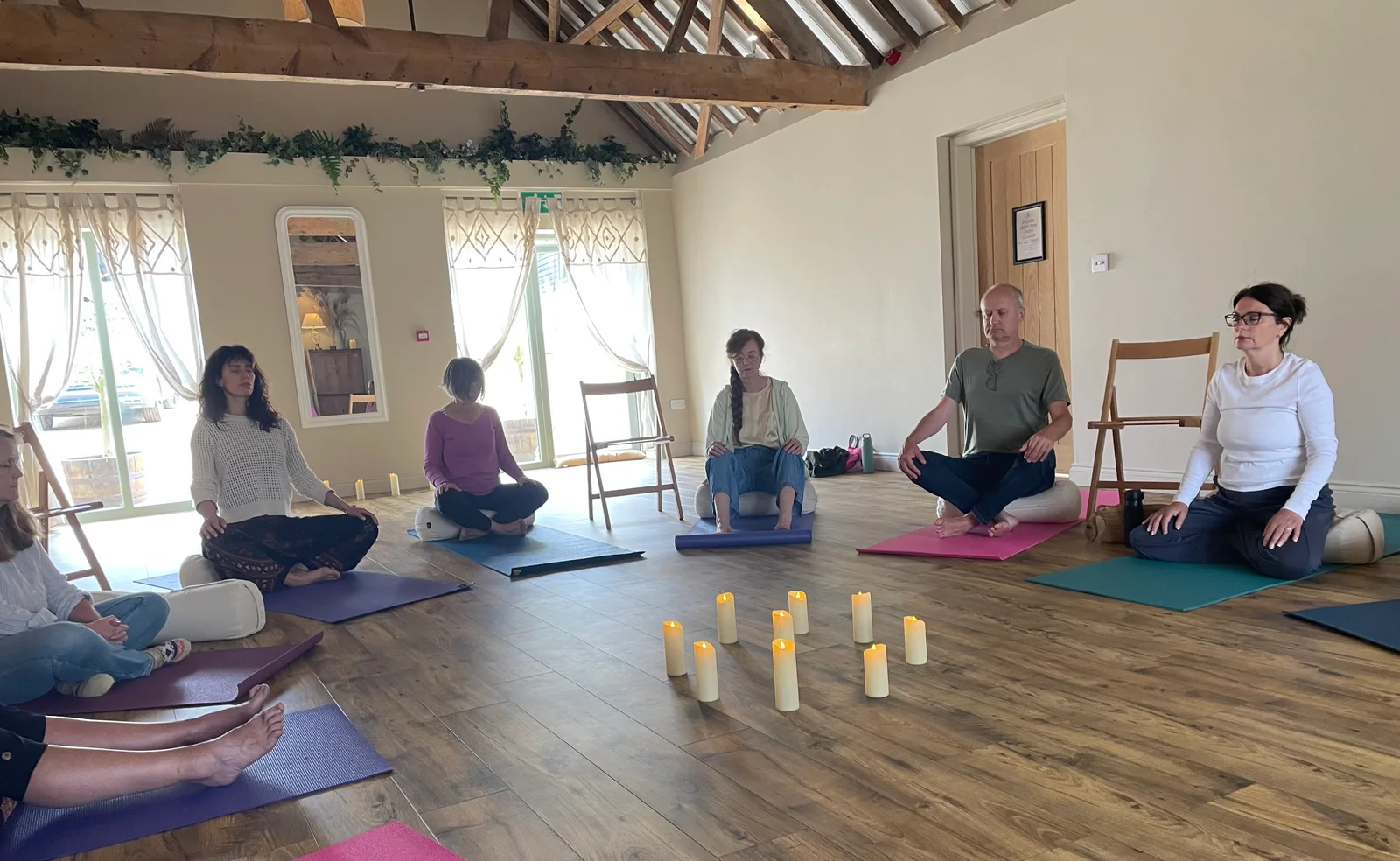
We finished as we always do, with tea and conversation in The Painted Barn, and it was a lively one this month.
Somewhere in it I was told about East Ruston Old Vicarage, a garden out toward the north-east coast that I had somehow never heard of, and which sounds precisely the sort of place to spend a day. It is Ania’s birthday this week. I suspect we know where we are going.
This is the part of the workshop I would not want to lose. The hour of practice matters, but the conversation afterwards is where people compare notes, ask the thing they did not want to ask in the room, and discover that the difficulty they thought was theirs alone is sitting at the table with them.
Come to the next one
Our Meditation workshop runs monthly on Saturdays at 1:30pm at The Painted Barn: an hour of teaching and practice, followed by tea. £10.
The next session is Saturday 15 August, and it is on the schedule and available to book now.
If you want to practise between workshops, the weekly Monday class at Barnham Broom Village Hall runs 5:00 to 5:25pm. Short, practice-led, and designed to fit around your week. £2, or £1 if you are already booking the 5:30pm Hatha Yoga class.
Everyone is welcome. You do not need experience, and you do not need to have found it easy.
